
Treatments
Preserve.
Restore.
Rebuild.
Focused on joint preservation, sports injuries and advanced orthopaedic surgery, with every treatment plan tailored to the individual patient.

Cartilage Transplantation
Osteochondral cartilage allografts are increasingly used in orthopaedic surgery. It is a treatment method particularly used for cartilage damage that is severe and cannot be repaired with other cartilage treatment methods. First used in America, this treatment method replaces damaged cartilage tissue with intact hyaline cartilage obtained from organ donors. Other cartilage treatment methods use fibrocartilage, which is weaker than the original cartilage. Since undamaged cartilage is transplanted with cartilage transplantation, patients have the opportunity to be treated with cartilage of a quality and strength that cannot be achieved with other treatment methods.
Knee Replacement
Knee replacement is a surgical procedure in which the damaged cartilage of the knee joint is removed and replaced with a metal joint implant attached to the thigh bone (femur) and shin bone (tibia). In most cases, bone cement is used to secure the prosthesis to the femur and tibia.
Hip Replacement
Hip replacement surgery is an effective treatment method currently used to treat many conditions affecting the hip. The aim of hip replacement surgery is to provide patients with a pain-free life while restoring full hip function.
Knee Arthroscopy
Knee arthroscopy is a procedure used to examine and treat the inside of the knee using an optical instrument called an arthroscope. The procedure can be performed under general, regional, or local anesthesia.
Ankle Arthroscopy
Knee arthroscopy is a procedure used to examine and treat the inside of the knee using an optical instrument called an arthroscope. The procedure can be performed under general, regional, or local anesthesia.
Shoulder Arthroscopy
Shoulder arthroscopy is a procedure used to examine and treat the inside of the shoulder joint using an optical instrument called an arthroscope, which is approximately 4 mm in diameter. The procedure is performed under general or regional anesthesia.
Knee Osteoarthritis
The cartilage in the knee is a highly specialized tissue that covers the ends of the femur and tibia, providing a smooth surface between the joint structures and allowing movement. Cartilage has limited capacity for self-repair, and the tissue formed during healing is mechanically weaker than the original cartilage.
Carpal Tunnel Syndrome
A nerve and the associated tendons travel from the forearm into the hand through a narrow passageway in the wrist and palm called the carpal tunnel. The nerve that passes through this tunnel is called the median nerve.
Acl Treatment
The knee has two cruciate ligaments, the anterior and posterior cruciate ligaments. These are strong structures that connect the thigh bone (femur) and shin bone (tibia) within the knee joint.
Clubfoot (Pes Ekinovarus) Treatment
Pes equinovarus, also known as clubfoot, is a congenital deformity in which the foot is turned inward and downward. It occurs in approximately 1 in 1,000 births and is more common in male infants.
Stem-Cell Therapy
Stem cells are cells that have the ability to differentiate into other cell types in the body and renew themselves. They essentially act as a source of new cells.
Follow my journey, cases and health tips on Instagram.
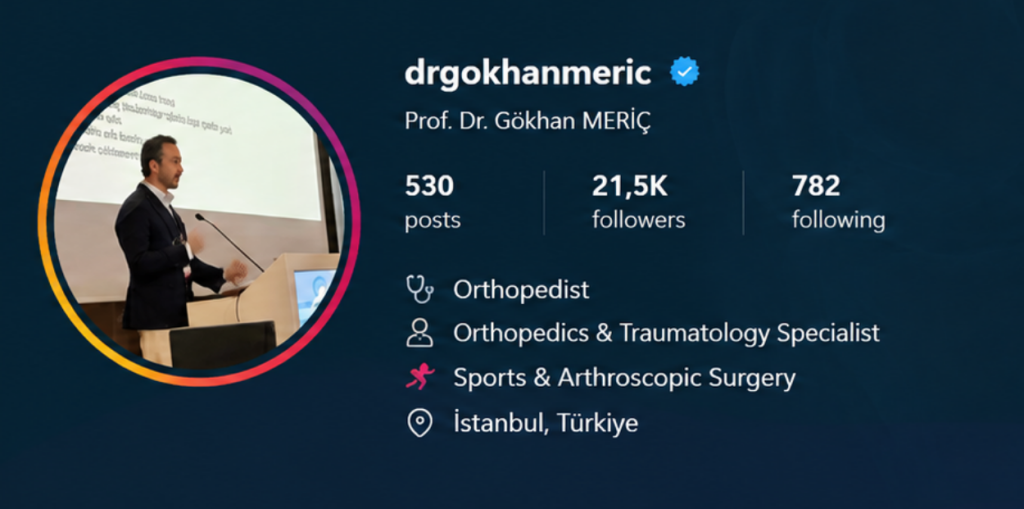
Stay updated for the latest treatments, patient stories and useful health tips.
